
Most Punjab and Sindh fields already hold locked phosphorus. Phosphate-solubilizing bacteria (PSB) help unlock it if you apply the right dose, at the right time, in contact with the root zone.
Farmers across Pakistan ask the same question every season: how much PSB biofertilizer per acre should I use, and when? Bags of DAP keep rising in cost, yet leaf tests still show phosphorus stress on alkaline and calcareous soils. The practical answer is not always more DAP. It is placing living phosphate-solubilizing microbes where roots can use them, then supporting soil biology so they survive heat, salinity and dry spells.
Mega Farmer BIOSO™ builds PSB capacity into the living-soil foundation product Soil-Revive 7-in-1, alongside complementary bacteria and fungi listed on the product page. Below is farmer-facing guidance for Pakistan conditions. Always adjust for soil test, irrigation method and crop stage. For measured field outcomes, see our Pakistan field trials rather than trusting random social-media percentages.
Pakistan farming is diverse: canal commands in Punjab, tube-well blocks with rising EC, tunnel vegetables near cities, and rainfed margins where organic matter is already thin. A living-soil program has to respect that diversity. Mega Farmer BIOSO™ from Xelora Industries PVT LTD in Lahore is built as a system, not a single miracle bottle. Soil-Revive rebuilds the base. Root, vegetative, reproductive and stress products then slot into the calendar you already run with your agronomist or progressive dealer.
What PSB actually does in Pakistani soils
Many soils in Punjab, KPK and interior Sindh test high in total phosphorus yet crops still respond to DAP. That is classic lockout: calcium and high pH bind P into forms roots cannot take up quickly. Phosphate-solubilizing bacteria and fungi produce organic acids and enzymes that release plant-available phosphate near the rhizosphere. They do not replace every kilogram of chemical P overnight. They improve the efficiency of whatever P is already in the field and of whatever DAP or SSP you still choose to apply.
When soil biology is weak after years of intensive chemistry, even good DAP placements underperform because the rhizosphere cannot keep P cycling. Rebuilding that community is why Soil-Revive sits at the front of Mega Farmer programs. Pair PSB with root establishment support from Root-Force Ultra when transplanting vegetables or establishing orchards. Stronger roots explore more soil volume, which multiplies the benefit of solubilized P.
Think of PSB as a delivery partner for phosphorus, not as a sticker that says zero fertiliser. Progressive growers keep a moderated basal and let biology stretch every rupee. That mindset also reduces the temptation to over-apply DAP into already locked soils where extra bags mostly feed fixation, not the crop.
Recommended Soil-Revive dosage bands (PSB-inclusive)
On the Soil-Revive product page we list a practical soil band of 3 to 5 L (or kg) per acre as a soil drench, with lighter houseplant rates for nursery use. Use the lower end on lighter soils with good organic matter and frequent irrigation. Use the upper end on compacted, saline or very alkaline blocks. Timing matters more than chasing a single magic number printed on a flyer.
- Before sowing / at land prep: Mix into the topsoil or apply as a drench so microbes colonize before the first irrigation flush.
- At establishment: Side-dress or drip-inject near the root zone for vegetables, potato and cotton.
- Mid-season maintenance: A lighter follow-up keeps biological activity when heat and pesticide sprays stress the microbiome.
- After harsh spray sequences: Ask us whether a recovery drench makes sense for your IPM calendar.
For canal or flood systems, dilute thoroughly and apply with the first or second irrigation so the inoculant moves into the root zone rather than baking on the surface. For drip, inject during the middle of the irrigation set so lines flush clean afterward. In hot months prefer evening application windows when soil surface temperatures drop.
Want a per-acre PSB plan for wheat, potato or vegetables? Message Mega Farmer BIOSO™ from Lahore — farmers and distributors get a reply within one working day.
Seed treatment and nursery trays
Where seed treatment is practical (wheat, maize, vegetables), a light slurry coat of inoculant before sowing improves early rhizosphere colonization. Keep treated seed out of harsh sun and sow soon after coating. In nurseries, a dilute drench using the houseplant-scale guidance on the Soil-Revive page helps plugs leave the tray with living biology already attached. Avoid soaking seed for long periods in dirty water that can invite pathogens. Clean containers and measured dilution beat casual mixing every time.
How to combine PSB with DAP without wasting money
Many progressive growers in Pakistan keep a reduced DAP basal and add microbial P support. The goal is efficiency: less locked bag P sitting unused in the soil, more plant-available P around roots. Do not dump concentrated fungicides into the same tank as living inoculants. Separate sprays by a day when possible, and avoid mixing with strong chlorine water. Soft organic matter or a carbon carrier helps microbes survive. Soil-Revive is designed around that living-soil idea.
For a deeper look at cutting fertiliser cost with microbial phosphorus, read how to reduce DAP cost with microbial phosphorus. Broader Pakistan context sits on our biofertilizer Pakistan hub. If micronutrient lockout is also visible on leaves, discuss MicroFoliar Plus so P gains are not masked by Zn or Fe stress.
Crop notes: cereals, potato, orchards
Wheat and other cereals
Apply at sowing or with first irrigation. Follow with vegetative support from MegaGrow-X if tillering looks weak. See also microbial inoculants for wheat in Pakistan. Record tiller counts on a few fixed spots so you can compare seasons honestly.
Potato
Potato responds strongly to early root and soil biology. Combine Soil-Revive at bed prep with the structured steps on our potato yield program. Field observations from Punjab blocks are summarised on field trials. We do not invent percentages here; ask for the latest trial notes on WhatsApp before you quote numbers to neighbours.
Orchards and Gulf sand
Sandy and desert systems need more frequent, lighter biology than heavy Punjab loams. Start with Soil-Revive as the carbon-microbe foundation, then layer stress and silicon tools such as Ultra Silicon Booster. Gulf growers should also open Gulf desert biofertilizer and desert sandy soil guidance for UAE and Saudi.
Practical checklist before you spray or drench
- Confirm irrigation water is not heavily chlorinated at the injection point.
- Shake or agitate the product; living formulations settle.
- Apply toward evening or under cloud when heat is lower.
- Keep soil moist for 24 to 48 hours after inoculation when possible.
- Record dose, date and block. Compare leaf colour and root digs, not only bag counts.
- Train labour on clean measuring so one acre does not receive a random double dose while the next acre gets foam.
Results vary with soil, weather and management. Mega Farmer publishes trial summaries on field trials rather than promising fixed yield percentages in blog copy.
Order PSB-inclusive Soil-Revive from Lahore
Soil-Revive 7-in-1 is available in pack sizes suited to small plots and commercial acreage. Order via WhatsApp +92-321-4999759 or email contact@megafarmer.store. Xelora Industries PVT LTD ships Mega Farmer BIOSO™ from Lahore to farms and distributors across Pakistan and selected Gulf projects. New buyers can follow buy biofertilizer online Pakistan for the message checklist.
Frequently asked questions
How much PSB biofertilizer per acre in Pakistan?
Soil-Revive 7-in-1, which carries the phosphate-solubilising organisms, is applied at 3–5 L or kg per acre as a soil drench: the low end on light soils with good organic matter, the high end on compacted, saline or very alkaline blocks.
Can PSB replace DAP completely?
No. PSB improves the efficiency of the phosphorus already in the soil and of the DAP you still apply. Keep a moderated basal and reduce gradually while watching leaf tests and root digs.
When is the best time to apply PSB?
At land preparation or with the first irrigation, then a lighter follow-up mid-season. Apply in the evening, keep soil moist for 24–48 hours and never tank-mix with fungicides or chlorinated water.
Products mentioned in this guide
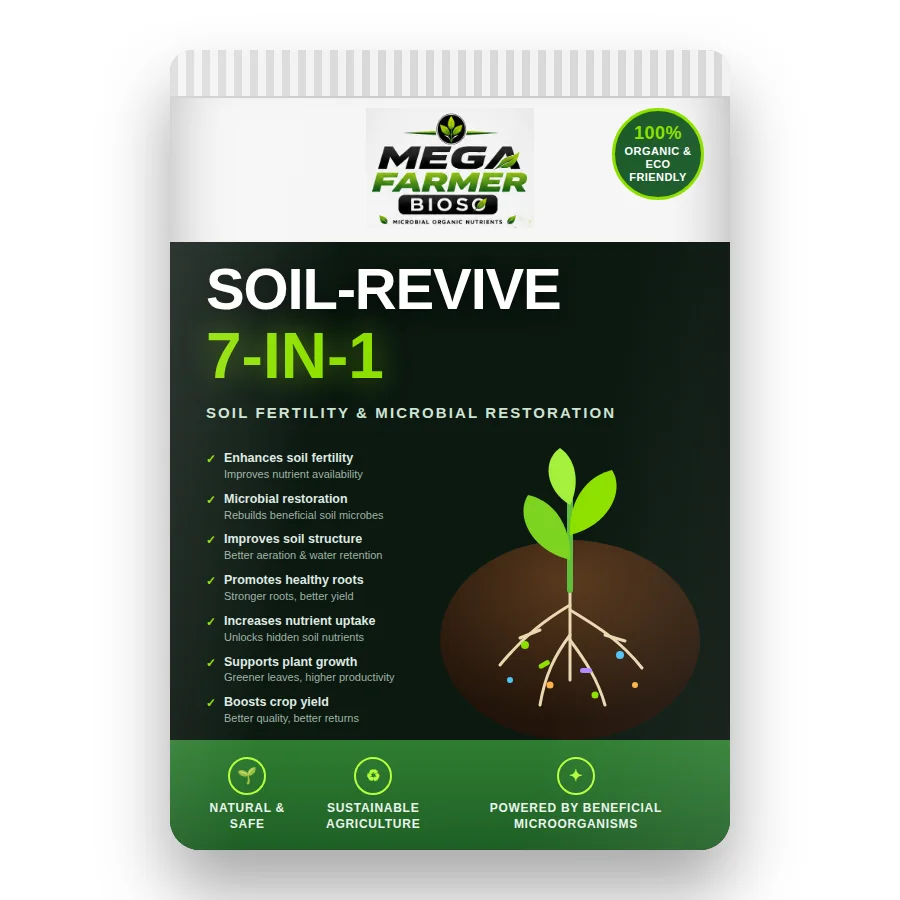
Soil-Revive 7-in-1
Soil fertility & microbial restoration
Azotobacter chroococcum · Bacillus subtilis · Bacillus megaterium · Bacillus mucilaginosus · Bacillus licheniformis
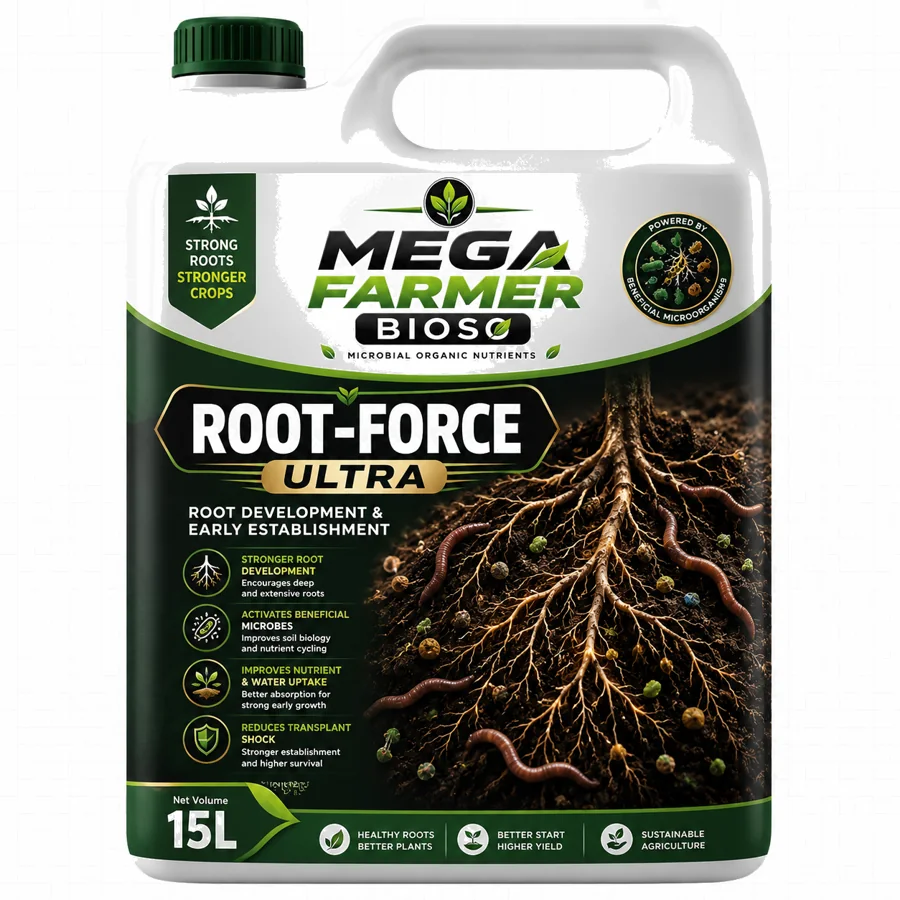
Root-Force Ultra
Root development & early establishment
Azospirillum brasilense · Bacillus subtilis · Bacillus amyloliquefaciens · Bacillus megaterium · Pseudomonas fluorescens
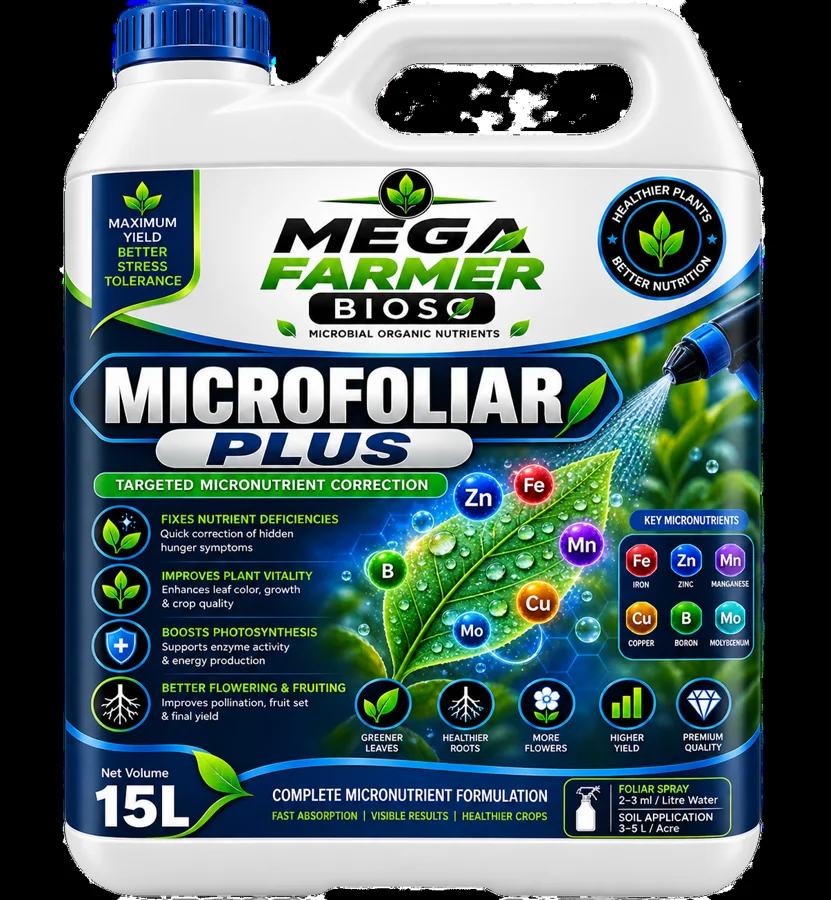
MicroFoliar Plus
Targeted micronutrient correction
Pseudomonas fluorescens
Results vary with soil, water, weather and management. Figures quoted from Mega Farmer field evaluations are single-season observations on named farms, not guarantees. Doses are label guidance — confirm with a soil test and your agronomist. Immuno-Shield is a root-colonising microbial soil conditioner used within IPM programmes; it is not a registered pesticide.